
Launched in 1983, the Infrared Astronomical Satellite (IRAS) revolutionized infrared astronomy as the first satellite to survey the entire sky at infrared (IR) wavelengths. During its 10-month mission, IRAS mapped the sky at 12-100 µm, catalogued >350,000 infrared sources (including debris disks and active galaxies), mapped Solar System zodiacal dust structures (including previously-undiscovered dust bands [Sykes & Greenberg, 1986]), and plus discovered ten small bodies (e.g. (3200) Phaethon and C/1983 H1). Less often highlighted is IRAS’s major contribution to the study and detection of planetary nebulae (PNe) and post-AGB stars. Not only did IRAS ultimately lead to the detection of more than forty PNe (and several PPNe), but they are historically significant as the first generation of PN and post-AGB stars discovered using satellite data. In particular, the catalogue of Dr. Andrea Preite-Martinez (1988) is discussed here, with various pretty examples shown in Fig. 1.

As most PNe lie along the dust-obscured Galactic plane, IRAS offered a major advantage over other surveys at the time, not only at detecting their intrinsic IR emissions through interstellar dust (e.g. Preite-Martinez, 1987,1988), but also at better distinguishing PNe from certain other Radio-emitting objects such as HII regions (Preite-Martinez, 1987,1988). In the case of PNe, Mid-Far-IR emissions arise from the star-heated dust released during the late-AGB phase, as well as from various emissions lines, including atomic (e.g. [Ar III], [N III], [S IV], [O IV]), and molecular (e.g. Si-O stretching, in the case of O-rich PNe). Though IRAS was equipped with a low resolution IR spectrometer (Pottasch et al., 1986), the selection criteria for the IRAS/Preite-Martinez PNe were purely photometric, and were defined according to already-known PNe, HII regions, OH/IR stars and YSOs: F(12)/F25) ≤ 0.35 and F(25)/F(60) ≥ 0.35 (e.g. IRAS 19084+0422 a.k.a. PM 1-285, Fig. 2). Preite-Martinez further divided their candidates into two sub-catalogues: “PM 1-X,” considered more likely to be true PNe based on their SEDs, and “PM 2-X,” considered less likely. Indeed, all PNe in Fig. 1 are part of the former list.

Sources meeting these criteria were flagged as “Possible PNe,” requiring follow-up observations (particularly optical spectroscopy: e.g., Suárez et al., 2006), for confirmation. Such observations can be challenging because, despite being bright at mid- to far-IR wavelengths, many candidates are optically faint due to interstellar extinction. At the time, available optical-IR imagery was also generally insufficient to resolve their morphologies. Modern surveys such as DECaPS and Pan-STARRS now reveal elliptical, bipolar, and circular structures among these objects, although most remain unresolved (i.e. “stellar”, such as IRAS 18524+0544, a.k.a. PM 1-264) (Fig. 1).
However, IRAS-detectable PNe partially overlap photometrically in the far-IR colors with some evolved (post-)AGB stars (e.g. Pottasch et al., 1988). In fact, follow-up studies of systematic IRAS PN searches (Pottasch et al., 1988; Preite-Martinez, 1988) uncovered not only very young, compact, dusty PNe (including some that turned out to be “OHPNe”: Cala et al., 2025), but also potential transitional objects such as proto-planetary nebulae (PPNe) (Sahai et al., 2005; Suarez et al., 2006), further helping bridge the AGB-PN transition. This is because the dusty circumstellar envelope [that leads to the bright IR signal] originates in the AGB-phase and is present (though progressively dissipating) through the PPN and PN phase, implying that late-AGB, PPN and young PNe practically share similar dust IR emissions.

To this day, many objects initially listed by Preite-Martinez (1988) remain unconfirmed as PNe by optical spectroscopy. Among them are the three objects in Fig. 4, all currently classified as “Possible PNe” in HASH. IRAS 18430−0636 (PM 1-256) appears as a compact, green stellar source in Pan-STARRS1 g+r+i images, similar to other young, compact PNe from Preite-Martinez (1988). The green colour likely traces nebular Hα emission in the PS1 r band, also supported by SHS Hα images. A possible weak NVSS radio counterpart, potentially tracing thermal free–free emission, further supports its nature as an emission object. IRAS 18415−1945 (PM 1-254) appears more evolved, showing a ~50″ circular nebula in SHS Hα images surrounding a blue central star, consistent with a circular PN and its CSPN.

In contrast, IRAS 17555−3621 (PM 1-196) lacks evident Hα and NVSS radio emission. However, DECaPS2 images reveal a central yellow source surrounded by bipolar blue nebulosity apparently unreported in the literature. These characteristics suggest a bipolar reflection nebula and potentially a previously unidentified PPN. Follow-up spectroscopy is required to establish its nature.
References
Cala, R. A., Gómez, J. F., Miranda, L. F., Imai, H., Anglada, G., de Gregorio-Monsalvo, I., … & Uscanga, L. (2025). Identification and characterization of nascent planetary nebulae with OH and H2O masers. Astronomy & Astrophysics, 703, A268.
Sykes, M. V., & Greenberg, R. (1986). The formation and origin of the IRAS zodiacal dust bands as a consequence of single collisions between asteroids. Icarus, 65(1), 51-69.
Pottasch, S. R., Preite-Martinez, A., Olnon, F. M., Mo, J. E., & Kingma, S. (1986). IRAS spectra planetary nebulae. III. Astronomy and Astrophysics (ISSN 0004-6361), vol. 161, no. 2, June 1986, p. 363-375., 161, 363-375.
Preite-Martinez, A. (1987). Search for possible planetary nebulae in the IRAS Point Source Catalog-Selection criteria. In CNR, National Conference on Infrared Astronomy, 2nd, Vulcano, Italy, Sept. 14-18, 1987 Società Astronomica Italiana, Memorie (ISSN 0037-8720), vol. 58, no. 2-3, 1987, p. 223-226. (Vol. 58, pp. 223-226).
Preite-Martinez, A. (1988). Possible new planetary nebulae in the IRAS point source catalogue. Astronomy and Astrophysics Supplement Series (ISSN 0365-0138), vol. 76, no. 3, Dec. 1988, p. 317-330., 76, 317-330.
Sahai, R., Le Mignant, D., Sánchez Contreras, C., Campbell, R. D., & Chaffee, F. H. (2005). Sculpting a Pre-planetary Nebula with a Precessing Jet: IRAS 16342–3814. The Astrophysical Journal Letters, 622(1), L53-L56.
Suárez, O., García-Lario, P., Manchado, A., Manteiga, M., Ulla, A., & Pottasch, S. R. (2006). A spectroscopic atlas of post-AGB stars and planetary nebulae selected from the IRAS point source catalogue. Astronomy & Astrophysics, 458(1), 173-180.
This blog post also makes use of the The University of Hong Kong/Australian Astronomical Observatory/Strasbourg Observatory H-alpha Planetary Nebula (HASH PN) database, the Legacy Survey Sky Browser and the NASA/IPAC Infrared Science Archive.


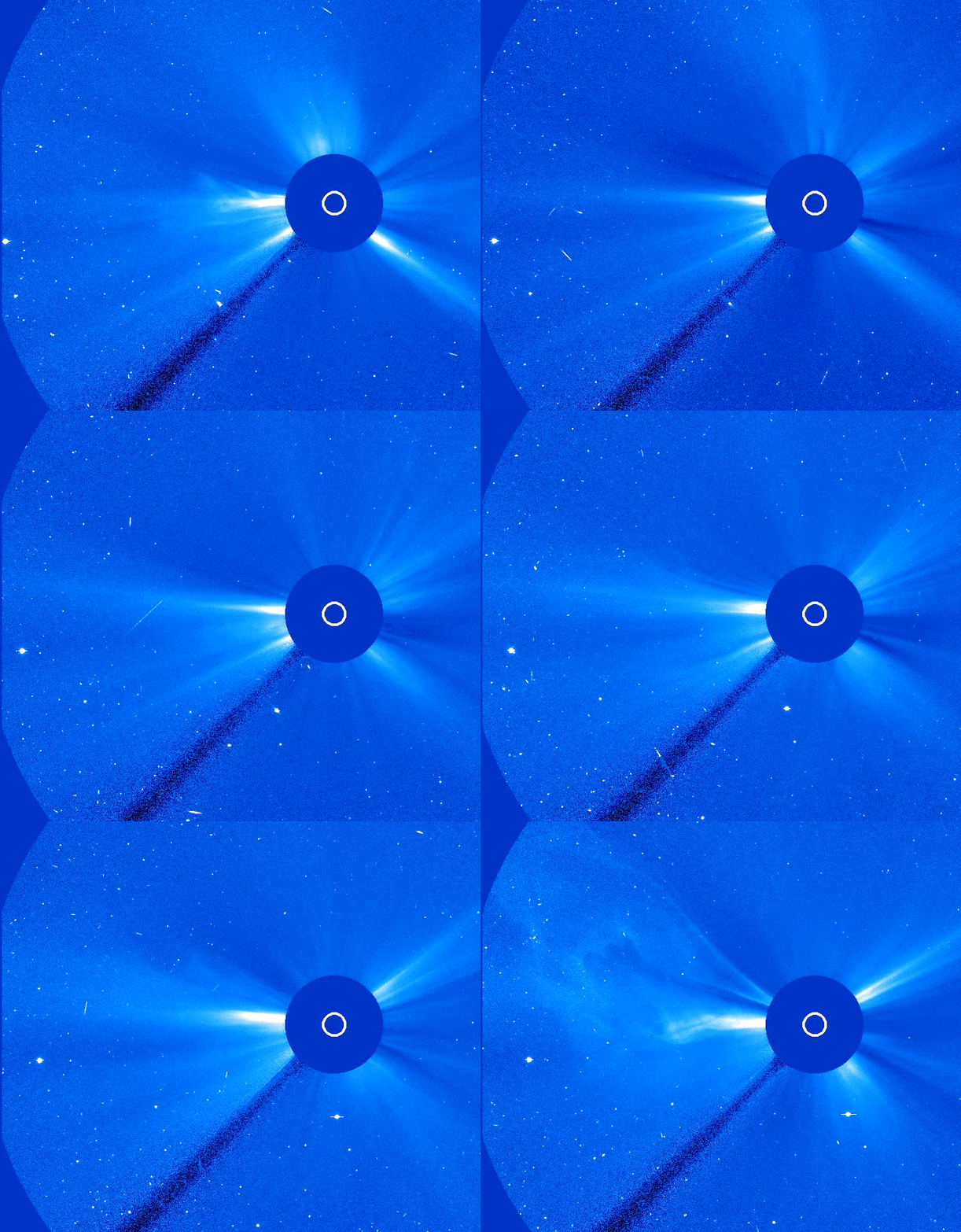
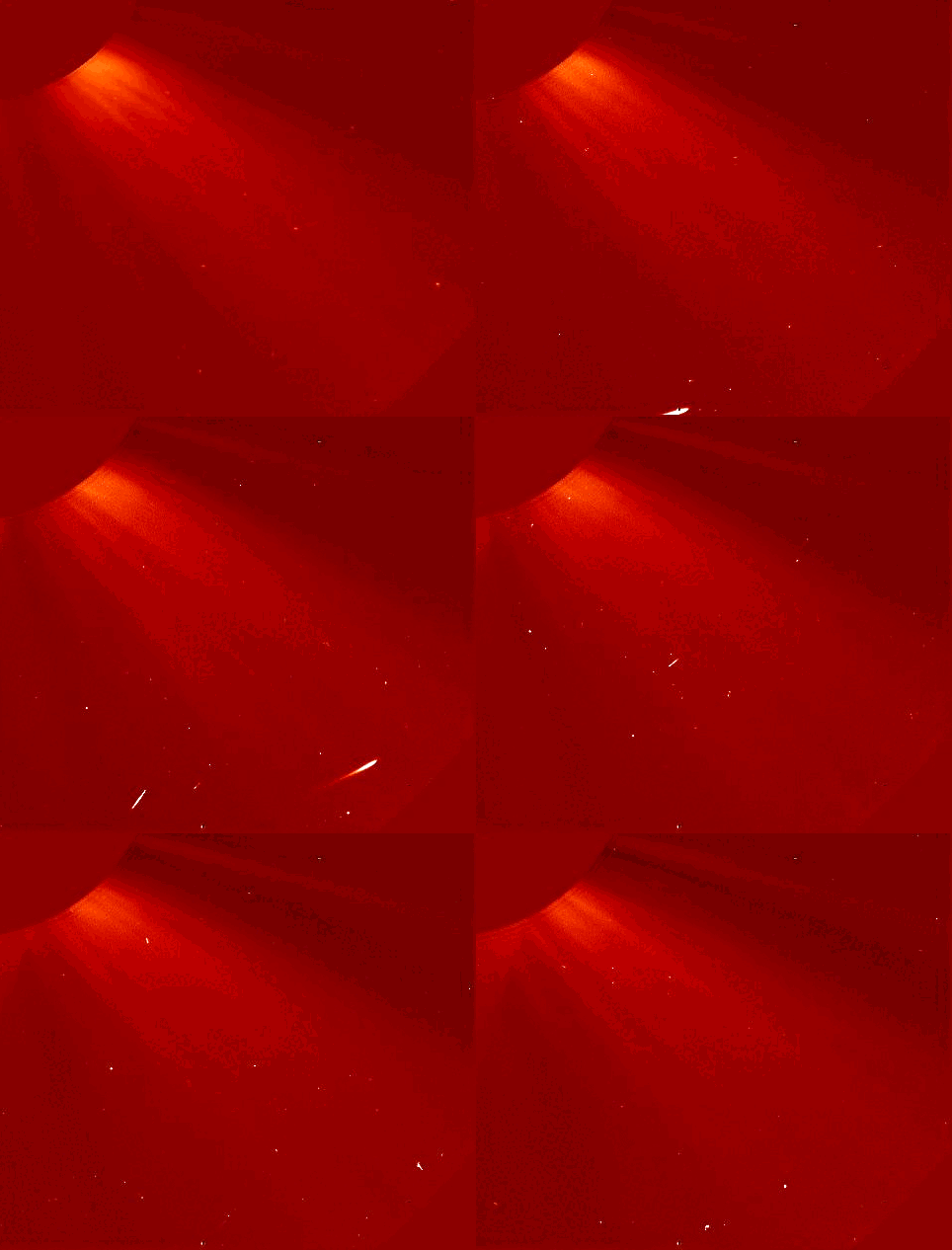

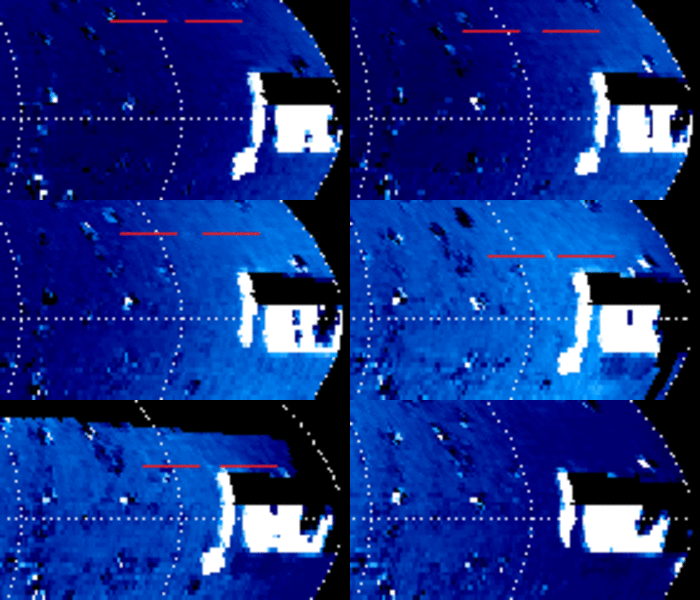

 Fig. 2: SOHO/LASCO C2 image extract showing C/2015 D1 (SOHO) on February 19th, 2015, only an hour before it left the FOV. Notice the saturation spikes, indicative that the comet probably reached was shining around mag +2 in this image. Image credit: ESA/NASA SOHO/LASCO C2.
 Fig. 3: One of two STEREO/SECCHI COR2-A image showing C/2015 D1 (SOHO). The images were taken during side-lobe operations hence the low resolution of this image. Als note Jupiter to the left of the Sun, and a massive CME. Image credit: NASA/SSC STEREO/SECCHI COR2-A.
 Fig. 4: Extract of Justin Cowart’s recovery image of C/2015 D1 (SOHO). This was the first ground-based image of the comet. (c) Justin Cowart.


